


Category of Astronomical Heritage: tangible immovable
The Astronomical Rock Panels in the Lascaux Cave, France
Format: Short Description (ICOMOS-IAU Case Study format)
Presentation
Geographical position
The Lascaux cave (Grotte de Lascaux) is situated in the valley of the river Vézère, 1200 m south-east of Montignac, Département de la Dordogne, France.
Location
Latitude 45° 3′ 17″ N, longitude 1° 10′ 44″ E. Elevation 185m above mean sea level.
General description
The Lascaux cave is embedded in the Santon limestone massif, its entrance being just below the top of Lascaux hill, c. 90 m above the valley floor of the Vézère. It comprises three long and narrow subterranean galleries in the form of a letter ‘K’ and measuring almost 250 m in length, including what have become known as the Axial Gallery, the Hall of the Bulls, the Chamber of Felines, the Nave, the Apse, and the Shaft. Covering most parts of the cave are numerous monochrome and polychrome paintings and engravings. The published corpus lists 1963 figures including animals (horse, aurochs, bison, ox, stag, ibex, feline, woolly rhinoceros, bird, bear), an anthropoid, a chimera, some possible abstract representations of plants, and symbols (geometric figures, series and sets of dots etc). Carbon-14 dates (from charcoal used sparingly for painting), pollen analysis and stylistic evaluations suggest that the majority of the rock pictures should be associated with the Lower Magdalenian, c. 17,000–15,000 BP, although it is possible that a few were created much later, in the Mesolithic (up to c. 5000 BC).
Brief inventory
A number of the Lascaux pictures have a possible astronomical significance. These include the ‘Chinese horse’ and ‘fronting ibex’ in the Axial Gallery and the ‘crossed bison’ in the Chamber of Felines (natural calendars); the stag-and-horse motif and related dots in the Axial Gallery and the five ‘swimming stags’ in the Nave (astronomical almanacs); the aurochs (no. 18) in the Hall of the Bulls with its clusters of dots (representations of asterisms); and two pictograph panels in the Shaft (cosmography). See also Cultural and symbolic dimension.
History
The cave was discovered on 12 September 1940 and rapidly started to attract large numbers of visitors. In 1948 it was opened to the public, but serious deterioration due to biological contamination resulted in it being closed again in 1963. A detailed three-dimensional replica of the cave’s most impressive galleries, the Axial Gallery and the Hall of the Bulls, was created just 200m away and has been open to the public since 1983. Meanwhile, efforts to halt the continuing deterioration of the original cave continue through to the present time.
Cultural and symbolic dimension
The suggested astronomical associations fall broadly into four categories:
- Natural calendars. The majority of the animals depicted at Lascaux show seasonal characteristic features: the deer are represented in their rutting season at the start of autumn, the horses at their time of mating and foaling in late winter/early spring, the ibexes at the time when they congregate in same-sex herds during the late summer/early autumn, and so on. These indications of particular seasons are sometimes enhanced by the addition of stylized plants: an example is the ‘Chinese horse’ in the Axial Gallery that is shown in its summer fur, highly pregnant and surrounded by stylized branches, illustrating the time of foaling around summer solstice.
- Astronomical almanacs. Some abstract designs associated with ‘seasonal’ animals may relate to astronomical calendars. For example, it is argued that a set of 13 dots and another of 26 appearing beneath a roaring stag and a pregnant horse (representing autumn and spring respectively) in the Axial Gallery represent the 13- and 26-week intervals from the summer solstice to the autumn equinox and then to the spring equinox, each spot counting 7 days.
- Representations of asterisms, particularly the Pleiades and Hyades. A cluster of dots above the back of the aurochs (no. 18) in the Hall of the Bulls resembles the Pleiades, while the animal’s eye and surrounding dots resemble Aldebaran (α Tau) and the Hyades, suggesting that the aurochs may be a distant forerunner of the constellation Taurus.
- Archaic cosmography. Two pictograph panels in the Shaft have been interpreted as representing the sky panorama as perceived by Magdalenian people from the top of the Lascaux hill at, for example, around midnight around the time of summer solstice in c. 16,500 BP.
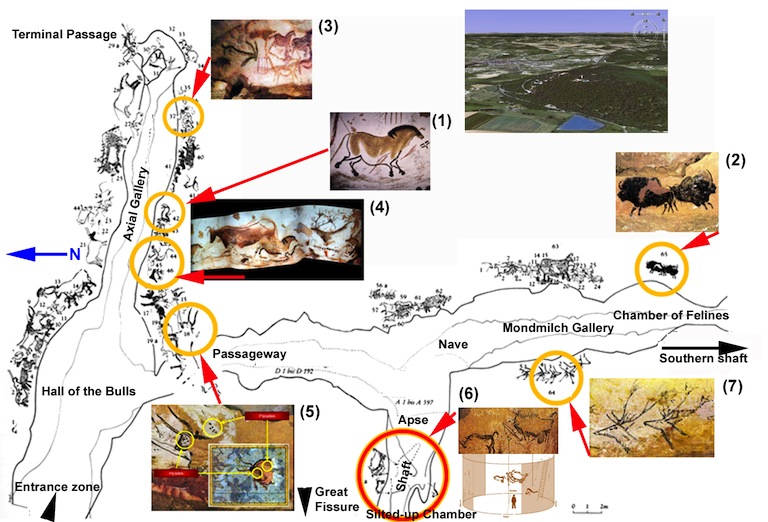
Fig. 1: Rock panels with possible astronomical associations in Lascaux cave. (1) The ‘Chinese horse’; (2) the ‘crossed bison’; (3) the ‘fronting ibex’; (4) the ‘roaring stag and pregnant horse motif’; (5) the aurochs (no. 18) and associated clusters of dots; (6) two pictograph panels of possible cosmographic significance; and (7) the ‘five swimming stags’. Adapted from a graphic by Michael Rappenglück
Comparative analysis
The Lascaux cave (Grotte de Lascaux) is situated in the valley of the river Vézère, 1200 m south-east of Montignac, Département de la Dordogne, France.
Location
Latitude 45° 3′ 17″ N, longitude 1° 10′ 44″ E. Elevation 185m above mean sea level.
General description
The Lascaux cave is embedded in the Santon limestone massif, its entrance being just below the top of Lascaux hill, c. 90 m above the valley floor of the Vézère. It comprises three long and narrow subterranean galleries in the form of a letter ‘K’ and measuring almost 250 m in length, including what have become known as the Axial Gallery, the Hall of the Bulls, the Chamber of Felines, the Nave, the Apse, and the Shaft. Covering most parts of the cave are numerous monochrome and polychrome paintings and engravings. The published corpus lists 1963 figures including animals (horse, aurochs, bison, ox, stag, ibex, feline, woolly rhinoceros, bird, bear), an anthropoid, a chimera, some possible abstract representations of plants, and symbols (geometric figures, series and sets of dots etc). Carbon-14 dates (from charcoal used sparingly for painting), pollen analysis and stylistic evaluations suggest that the majority of the rock pictures should be associated with the Lower Magdalenian, c. 17,000–15,000 BP, although it is possible that a few were created much later, in the Mesolithic (up to c. 5000 BC).
Brief inventory
A number of the Lascaux pictures have a possible astronomical significance. These include the ‘Chinese horse’ and ‘fronting ibex’ in the Axial Gallery and the ‘crossed bison’ in the Chamber of Felines (natural calendars); the stag-and-horse motif and related dots in the Axial Gallery and the five ‘swimming stags’ in the Nave (astronomical almanacs); the aurochs (no. 18) in the Hall of the Bulls with its clusters of dots (representations of asterisms); and two pictograph panels in the Shaft (cosmography). See also Cultural and symbolic dimension.
History
The cave was discovered on 12 September 1940 and rapidly started to attract large numbers of visitors. In 1948 it was opened to the public, but serious deterioration due to biological contamination resulted in it being closed again in 1963. A detailed three-dimensional replica of the cave’s most impressive galleries, the Axial Gallery and the Hall of the Bulls, was created just 200m away and has been open to the public since 1983. Meanwhile, efforts to halt the continuing deterioration of the original cave continue through to the present time.
Cultural and symbolic dimension
The suggested astronomical associations fall broadly into four categories:
- Natural calendars. The majority of the animals depicted at Lascaux show seasonal characteristic features: the deer are represented in their rutting season at the start of autumn, the horses at their time of mating and foaling in late winter/early spring, the ibexes at the time when they congregate in same-sex herds during the late summer/early autumn, and so on. These indications of particular seasons are sometimes enhanced by the addition of stylized plants: an example is the ‘Chinese horse’ in the Axial Gallery that is shown in its summer fur, highly pregnant and surrounded by stylized branches, illustrating the time of foaling around summer solstice.
- Astronomical almanacs. Some abstract designs associated with ‘seasonal’ animals may relate to astronomical calendars. For example, it is argued that a set of 13 dots and another of 26 appearing beneath a roaring stag and a pregnant horse (representing autumn and spring respectively) in the Axial Gallery represent the 13- and 26-week intervals from the summer solstice to the autumn equinox and then to the spring equinox, each spot counting 7 days.
- Representations of asterisms, particularly the Pleiades and Hyades. A cluster of dots above the back of the aurochs (no. 18) in the Hall of the Bulls resembles the Pleiades, while the animal’s eye and surrounding dots resemble Aldebaran (α Tau) and the Hyades, suggesting that the aurochs may be a distant forerunner of the constellation Taurus.
- Archaic cosmography. Two pictograph panels in the Shaft have been interpreted as representing the sky panorama as perceived by Magdalenian people from the top of the Lascaux hill at, for example, around midnight around the time of summer solstice in c. 16,500 BP.
Fig. 1: Rock panels with possible astronomical associations in Lascaux cave. (1) The ‘Chinese horse’; (2) the ‘crossed bison’; (3) the ‘fronting ibex’; (4) the ‘roaring stag and pregnant horse motif’; (5) the aurochs (no. 18) and associated clusters of dots; (6) two pictograph panels of possible cosmographic significance; and (7) the ‘five swimming stags’. Adapted from a graphic by Michael Rappenglück
Comparative analysis
Latitude 45° 3′ 17″ N, longitude 1° 10′ 44″ E. Elevation 185m above mean sea level.
General description
The Lascaux cave is embedded in the Santon limestone massif, its entrance being just below the top of Lascaux hill, c. 90 m above the valley floor of the Vézère. It comprises three long and narrow subterranean galleries in the form of a letter ‘K’ and measuring almost 250 m in length, including what have become known as the Axial Gallery, the Hall of the Bulls, the Chamber of Felines, the Nave, the Apse, and the Shaft. Covering most parts of the cave are numerous monochrome and polychrome paintings and engravings. The published corpus lists 1963 figures including animals (horse, aurochs, bison, ox, stag, ibex, feline, woolly rhinoceros, bird, bear), an anthropoid, a chimera, some possible abstract representations of plants, and symbols (geometric figures, series and sets of dots etc). Carbon-14 dates (from charcoal used sparingly for painting), pollen analysis and stylistic evaluations suggest that the majority of the rock pictures should be associated with the Lower Magdalenian, c. 17,000–15,000 BP, although it is possible that a few were created much later, in the Mesolithic (up to c. 5000 BC).
Brief inventory
A number of the Lascaux pictures have a possible astronomical significance. These include the ‘Chinese horse’ and ‘fronting ibex’ in the Axial Gallery and the ‘crossed bison’ in the Chamber of Felines (natural calendars); the stag-and-horse motif and related dots in the Axial Gallery and the five ‘swimming stags’ in the Nave (astronomical almanacs); the aurochs (no. 18) in the Hall of the Bulls with its clusters of dots (representations of asterisms); and two pictograph panels in the Shaft (cosmography). See also Cultural and symbolic dimension.
History
The cave was discovered on 12 September 1940 and rapidly started to attract large numbers of visitors. In 1948 it was opened to the public, but serious deterioration due to biological contamination resulted in it being closed again in 1963. A detailed three-dimensional replica of the cave’s most impressive galleries, the Axial Gallery and the Hall of the Bulls, was created just 200m away and has been open to the public since 1983. Meanwhile, efforts to halt the continuing deterioration of the original cave continue through to the present time.
Cultural and symbolic dimension
The suggested astronomical associations fall broadly into four categories:
- Natural calendars. The majority of the animals depicted at Lascaux show seasonal characteristic features: the deer are represented in their rutting season at the start of autumn, the horses at their time of mating and foaling in late winter/early spring, the ibexes at the time when they congregate in same-sex herds during the late summer/early autumn, and so on. These indications of particular seasons are sometimes enhanced by the addition of stylized plants: an example is the ‘Chinese horse’ in the Axial Gallery that is shown in its summer fur, highly pregnant and surrounded by stylized branches, illustrating the time of foaling around summer solstice.
- Astronomical almanacs. Some abstract designs associated with ‘seasonal’ animals may relate to astronomical calendars. For example, it is argued that a set of 13 dots and another of 26 appearing beneath a roaring stag and a pregnant horse (representing autumn and spring respectively) in the Axial Gallery represent the 13- and 26-week intervals from the summer solstice to the autumn equinox and then to the spring equinox, each spot counting 7 days.
- Representations of asterisms, particularly the Pleiades and Hyades. A cluster of dots above the back of the aurochs (no. 18) in the Hall of the Bulls resembles the Pleiades, while the animal’s eye and surrounding dots resemble Aldebaran (α Tau) and the Hyades, suggesting that the aurochs may be a distant forerunner of the constellation Taurus.
- Archaic cosmography. Two pictograph panels in the Shaft have been interpreted as representing the sky panorama as perceived by Magdalenian people from the top of the Lascaux hill at, for example, around midnight around the time of summer solstice in c. 16,500 BP.
Fig. 1: Rock panels with possible astronomical associations in Lascaux cave. (1) The ‘Chinese horse’; (2) the ‘crossed bison’; (3) the ‘fronting ibex’; (4) the ‘roaring stag and pregnant horse motif’; (5) the aurochs (no. 18) and associated clusters of dots; (6) two pictograph panels of possible cosmographic significance; and (7) the ‘five swimming stags’. Adapted from a graphic by Michael Rappenglück
Comparative analysis
The Lascaux cave is embedded in the Santon limestone massif, its entrance being just below the top of Lascaux hill, c. 90 m above the valley floor of the Vézère. It comprises three long and narrow subterranean galleries in the form of a letter ‘K’ and measuring almost 250 m in length, including what have become known as the Axial Gallery, the Hall of the Bulls, the Chamber of Felines, the Nave, the Apse, and the Shaft. Covering most parts of the cave are numerous monochrome and polychrome paintings and engravings. The published corpus lists 1963 figures including animals (horse, aurochs, bison, ox, stag, ibex, feline, woolly rhinoceros, bird, bear), an anthropoid, a chimera, some possible abstract representations of plants, and symbols (geometric figures, series and sets of dots etc). Carbon-14 dates (from charcoal used sparingly for painting), pollen analysis and stylistic evaluations suggest that the majority of the rock pictures should be associated with the Lower Magdalenian, c. 17,000–15,000 BP, although it is possible that a few were created much later, in the Mesolithic (up to c. 5000 BC).
Brief inventory
A number of the Lascaux pictures have a possible astronomical significance. These include the ‘Chinese horse’ and ‘fronting ibex’ in the Axial Gallery and the ‘crossed bison’ in the Chamber of Felines (natural calendars); the stag-and-horse motif and related dots in the Axial Gallery and the five ‘swimming stags’ in the Nave (astronomical almanacs); the aurochs (no. 18) in the Hall of the Bulls with its clusters of dots (representations of asterisms); and two pictograph panels in the Shaft (cosmography). See also Cultural and symbolic dimension.
History
The cave was discovered on 12 September 1940 and rapidly started to attract large numbers of visitors. In 1948 it was opened to the public, but serious deterioration due to biological contamination resulted in it being closed again in 1963. A detailed three-dimensional replica of the cave’s most impressive galleries, the Axial Gallery and the Hall of the Bulls, was created just 200m away and has been open to the public since 1983. Meanwhile, efforts to halt the continuing deterioration of the original cave continue through to the present time.
Cultural and symbolic dimension
The suggested astronomical associations fall broadly into four categories:
- Natural calendars. The majority of the animals depicted at Lascaux show seasonal characteristic features: the deer are represented in their rutting season at the start of autumn, the horses at their time of mating and foaling in late winter/early spring, the ibexes at the time when they congregate in same-sex herds during the late summer/early autumn, and so on. These indications of particular seasons are sometimes enhanced by the addition of stylized plants: an example is the ‘Chinese horse’ in the Axial Gallery that is shown in its summer fur, highly pregnant and surrounded by stylized branches, illustrating the time of foaling around summer solstice.
- Astronomical almanacs. Some abstract designs associated with ‘seasonal’ animals may relate to astronomical calendars. For example, it is argued that a set of 13 dots and another of 26 appearing beneath a roaring stag and a pregnant horse (representing autumn and spring respectively) in the Axial Gallery represent the 13- and 26-week intervals from the summer solstice to the autumn equinox and then to the spring equinox, each spot counting 7 days.
- Representations of asterisms, particularly the Pleiades and Hyades. A cluster of dots above the back of the aurochs (no. 18) in the Hall of the Bulls resembles the Pleiades, while the animal’s eye and surrounding dots resemble Aldebaran (α Tau) and the Hyades, suggesting that the aurochs may be a distant forerunner of the constellation Taurus.
- Archaic cosmography. Two pictograph panels in the Shaft have been interpreted as representing the sky panorama as perceived by Magdalenian people from the top of the Lascaux hill at, for example, around midnight around the time of summer solstice in c. 16,500 BP.
Fig. 1: Rock panels with possible astronomical associations in Lascaux cave. (1) The ‘Chinese horse’; (2) the ‘crossed bison’; (3) the ‘fronting ibex’; (4) the ‘roaring stag and pregnant horse motif’; (5) the aurochs (no. 18) and associated clusters of dots; (6) two pictograph panels of possible cosmographic significance; and (7) the ‘five swimming stags’. Adapted from a graphic by Michael Rappenglück
Comparative analysis
A number of the Lascaux pictures have a possible astronomical significance. These include the ‘Chinese horse’ and ‘fronting ibex’ in the Axial Gallery and the ‘crossed bison’ in the Chamber of Felines (natural calendars); the stag-and-horse motif and related dots in the Axial Gallery and the five ‘swimming stags’ in the Nave (astronomical almanacs); the aurochs (no. 18) in the Hall of the Bulls with its clusters of dots (representations of asterisms); and two pictograph panels in the Shaft (cosmography). See also Cultural and symbolic dimension.
History
The cave was discovered on 12 September 1940 and rapidly started to attract large numbers of visitors. In 1948 it was opened to the public, but serious deterioration due to biological contamination resulted in it being closed again in 1963. A detailed three-dimensional replica of the cave’s most impressive galleries, the Axial Gallery and the Hall of the Bulls, was created just 200m away and has been open to the public since 1983. Meanwhile, efforts to halt the continuing deterioration of the original cave continue through to the present time.
Cultural and symbolic dimension
The suggested astronomical associations fall broadly into four categories:
- Natural calendars. The majority of the animals depicted at Lascaux show seasonal characteristic features: the deer are represented in their rutting season at the start of autumn, the horses at their time of mating and foaling in late winter/early spring, the ibexes at the time when they congregate in same-sex herds during the late summer/early autumn, and so on. These indications of particular seasons are sometimes enhanced by the addition of stylized plants: an example is the ‘Chinese horse’ in the Axial Gallery that is shown in its summer fur, highly pregnant and surrounded by stylized branches, illustrating the time of foaling around summer solstice.
- Astronomical almanacs. Some abstract designs associated with ‘seasonal’ animals may relate to astronomical calendars. For example, it is argued that a set of 13 dots and another of 26 appearing beneath a roaring stag and a pregnant horse (representing autumn and spring respectively) in the Axial Gallery represent the 13- and 26-week intervals from the summer solstice to the autumn equinox and then to the spring equinox, each spot counting 7 days.
- Representations of asterisms, particularly the Pleiades and Hyades. A cluster of dots above the back of the aurochs (no. 18) in the Hall of the Bulls resembles the Pleiades, while the animal’s eye and surrounding dots resemble Aldebaran (α Tau) and the Hyades, suggesting that the aurochs may be a distant forerunner of the constellation Taurus.
- Archaic cosmography. Two pictograph panels in the Shaft have been interpreted as representing the sky panorama as perceived by Magdalenian people from the top of the Lascaux hill at, for example, around midnight around the time of summer solstice in c. 16,500 BP.
Fig. 1: Rock panels with possible astronomical associations in Lascaux cave. (1) The ‘Chinese horse’; (2) the ‘crossed bison’; (3) the ‘fronting ibex’; (4) the ‘roaring stag and pregnant horse motif’; (5) the aurochs (no. 18) and associated clusters of dots; (6) two pictograph panels of possible cosmographic significance; and (7) the ‘five swimming stags’. Adapted from a graphic by Michael Rappenglück
Comparative analysis
The cave was discovered on 12 September 1940 and rapidly started to attract large numbers of visitors. In 1948 it was opened to the public, but serious deterioration due to biological contamination resulted in it being closed again in 1963. A detailed three-dimensional replica of the cave’s most impressive galleries, the Axial Gallery and the Hall of the Bulls, was created just 200m away and has been open to the public since 1983. Meanwhile, efforts to halt the continuing deterioration of the original cave continue through to the present time.
Cultural and symbolic dimension
The suggested astronomical associations fall broadly into four categories:
- Natural calendars. The majority of the animals depicted at Lascaux show seasonal characteristic features: the deer are represented in their rutting season at the start of autumn, the horses at their time of mating and foaling in late winter/early spring, the ibexes at the time when they congregate in same-sex herds during the late summer/early autumn, and so on. These indications of particular seasons are sometimes enhanced by the addition of stylized plants: an example is the ‘Chinese horse’ in the Axial Gallery that is shown in its summer fur, highly pregnant and surrounded by stylized branches, illustrating the time of foaling around summer solstice.
- Astronomical almanacs. Some abstract designs associated with ‘seasonal’ animals may relate to astronomical calendars. For example, it is argued that a set of 13 dots and another of 26 appearing beneath a roaring stag and a pregnant horse (representing autumn and spring respectively) in the Axial Gallery represent the 13- and 26-week intervals from the summer solstice to the autumn equinox and then to the spring equinox, each spot counting 7 days.
- Representations of asterisms, particularly the Pleiades and Hyades. A cluster of dots above the back of the aurochs (no. 18) in the Hall of the Bulls resembles the Pleiades, while the animal’s eye and surrounding dots resemble Aldebaran (α Tau) and the Hyades, suggesting that the aurochs may be a distant forerunner of the constellation Taurus.
- Archaic cosmography. Two pictograph panels in the Shaft have been interpreted as representing the sky panorama as perceived by Magdalenian people from the top of the Lascaux hill at, for example, around midnight around the time of summer solstice in c. 16,500 BP.
Fig. 1: Rock panels with possible astronomical associations in Lascaux cave. (1) The ‘Chinese horse’; (2) the ‘crossed bison’; (3) the ‘fronting ibex’; (4) the ‘roaring stag and pregnant horse motif’; (5) the aurochs (no. 18) and associated clusters of dots; (6) two pictograph panels of possible cosmographic significance; and (7) the ‘five swimming stags’. Adapted from a graphic by Michael Rappenglück
Comparative analysis
The suggested astronomical associations fall broadly into four categories:
- Natural calendars. The majority of the animals depicted at Lascaux show seasonal characteristic features: the deer are represented in their rutting season at the start of autumn, the horses at their time of mating and foaling in late winter/early spring, the ibexes at the time when they congregate in same-sex herds during the late summer/early autumn, and so on. These indications of particular seasons are sometimes enhanced by the addition of stylized plants: an example is the ‘Chinese horse’ in the Axial Gallery that is shown in its summer fur, highly pregnant and surrounded by stylized branches, illustrating the time of foaling around summer solstice.
- Astronomical almanacs. Some abstract designs associated with ‘seasonal’ animals may relate to astronomical calendars. For example, it is argued that a set of 13 dots and another of 26 appearing beneath a roaring stag and a pregnant horse (representing autumn and spring respectively) in the Axial Gallery represent the 13- and 26-week intervals from the summer solstice to the autumn equinox and then to the spring equinox, each spot counting 7 days.
- Representations of asterisms, particularly the Pleiades and Hyades. A cluster of dots above the back of the aurochs (no. 18) in the Hall of the Bulls resembles the Pleiades, while the animal’s eye and surrounding dots resemble Aldebaran (α Tau) and the Hyades, suggesting that the aurochs may be a distant forerunner of the constellation Taurus.
- Archaic cosmography. Two pictograph panels in the Shaft have been interpreted as representing the sky panorama as perceived by Magdalenian people from the top of the Lascaux hill at, for example, around midnight around the time of summer solstice in c. 16,500 BP.